
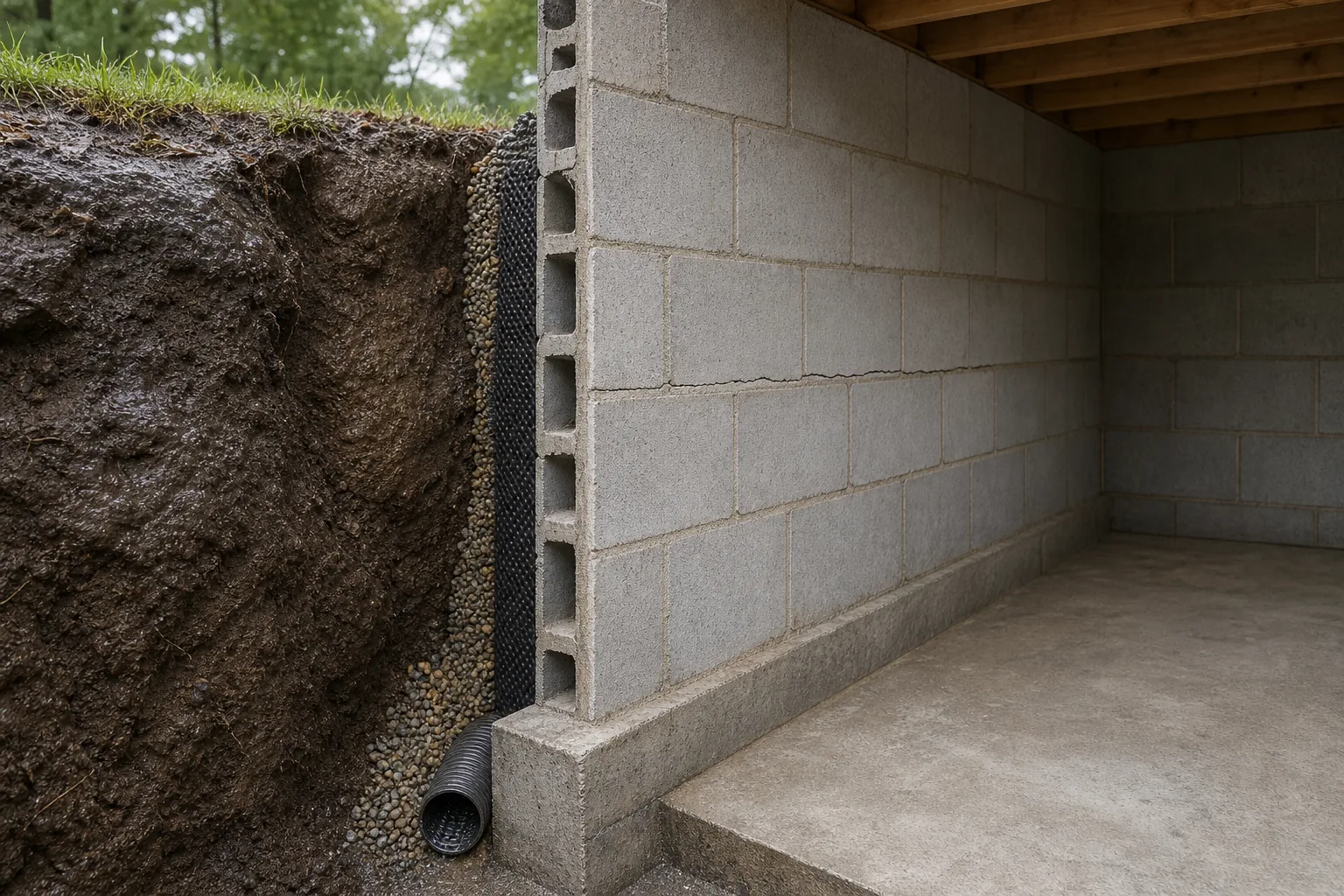
A horizontal crack in basement wall deserves a closer look because it can be associated with sideways pressure and wall movement. The crack alone cannot identify the cause or tell you how serious the condition is, but its location, changes over time, and any bowing or water nearby give useful clues. For Indianapolis homeowners, the sensible next step is to document what you see, improve basic water management, and arrange an assessment if the crack changes or the wall moves.
What does a horizontal crack in a basement wall mean?
A horizontal crack runs left to right rather than from the floor toward the ceiling. It is different from a small, isolated shrinkage crack because its pattern can point to force acting from the outside of the wall. The American Society of Home Inspectors notes that wet soil, poor surface-water management, and frost can contribute to horizontal cracking in block walls. Read ASHI’s homeowner guidance on basement cracks and leaks.
That does not mean every horizontal line is proof of a major structural problem. A crack is one part of the picture. Whether the wall is bowed, whether the crack is opening, and whether there are other crack patterns matter more than trying to judge it from one photo.
Block wall or poured concrete: does the pattern change?
Start by identifying the wall material. A concrete block wall has rectangular units separated by mortar joints. A poured-concrete wall is one continuous surface, often with vertical form lines or a smoother texture.
On a block wall, a horizontal crack often follows a mortar joint. That makes the line easy to spot, especially if the joint has separated more in one area than another. On poured concrete, a horizontal crack cuts across the wall itself instead of following individual blocks. Either wall type should be evaluated in context; do not assume that a crack in one material has the same cause or urgency as a similar-looking crack in another.
ASHI explains that block walls have less resistance to horizontal pressure than poured concrete walls. That is why a crack along a mortar joint, particularly with an inward curve, calls for careful observation rather than a cosmetic patch.
Why can basement walls crack sideways in central Indiana?
The local context here is practical: EverDry serves Indianapolis and central Indiana, where homes experience rain and winter weather. Water that stays near a foundation can keep surrounding soil wet. According to ASHI, wet soil, inadequate surface-water maintenance, and frost are factors associated with horizontal cracks in block walls.
Here are common conditions to look for around your own house:
- Water collecting beside the foundation. After a rain, note puddles, muddy spots, or a gutter overflow near the cracked wall. Surface water reaching the exterior wall can contribute to seepage and wet soil.
- Downspouts dropping water at the wall. Watch a rainfall if possible. If water leaves the downspout right beside the house or washes back toward it, it deserves correction.
- Soil that slopes toward the house. A low spot against the wall gives water a place to collect. The issue is not simply the appearance of the grade; it is where water actually travels and remains after rain.
- Freeze-and-thaw exposure. Soil can move as it freezes and thaws. If the crack seems more noticeable after winter or shifts with the seasons, record that pattern for the professional who evaluates it.
- A wall already showing movement. A horizontal crack paired with an inward bulge, displaced blocks, or stair-step cracks provides more information than the crack alone.
Avoid digging beside the affected wall or pushing on it to “test” it. Those actions do not diagnose the condition and can create additional risk or hide useful evidence.
How wide, how long, how recent: what to record safely
You do not need to decide the repair yourself. A consistent record makes it easier to explain what you have noticed.
Take several clear photos in good light: one of the complete wall, one of each end of the crack, and a close-up with a ruler held alongside it for scale. Put the date in your photo filename or notes. You can also make a small dated pencil mark at each end of the crack on the wall surface—not across the crack—and compare the same spots after heavy rain and over the next several weeks.
Look, but do not touch or alter the wall. Record whether the crack seems longer or wider, whether one section projects inward, whether moisture appears at the line, and whether a nearby door or window has begun to stick. These observations are more useful than a one-time width measurement.
| What you see | What it may suggest | What to document | First next step |
|---|---|---|---|
| Thin, stable line at one mortar joint | A condition to monitor | Dated photos and crack length | Check again after rain and seasonal changes |
| Crack opening wider or extending | Possible ongoing movement | Dates, photos, and changed areas | Arrange a professional assessment |
| Crack with an inward bulge | Wall displacement needs attention | Whole-wall photos from an angle | Contact a foundation professional promptly |
| Crack plus stair-step or vertical cracks | More than one movement pattern | Photo each pattern and location | Have the wall evaluated |
| Water at the crack after rain | Water-management issue may be involved | Rain timing and water location | Check drainage; request an assessment |
What can you check outside this week?
Focus on simple observation and routine upkeep, not a DIY crack repair. During or shortly after rain, walk the exterior near the cracked wall and follow the path of water from the roof and yard.
- Clear leaves and debris that prevent gutters from draining as intended.
- Confirm that downspout discharge is not emptying immediately beside the foundation.
- Look for settled mulch, soil, or landscaping that directs water against the house.
- Note standing water and the time it takes to drain away.
These checks address the water around the home, not the crack itself. Do not cover the crack with sealant or a patch just to make it disappear. That can make later changes harder to see and does not establish why the wall cracked. If water is entering, foundation waterproofing may be part of the discussion after the source of the issue is assessed.
When should a professional look at it?
Do not wait to seek an assessment if the crack is widening, the wall has an inward bulge, blocks look displaced, or multiple crack patterns appear together. Repeated water at the crack, a noticeable change after a storm or winter, or new sticking doors and windows are also useful reasons to move from monitoring to evaluation.
A professional can look at the crack pattern, the wall’s alignment, and the water conditions around the foundation rather than treating the visible line in isolation. EverDry provides horizontal crack repair information for homeowners dealing with this issue. For local service details, see its foundation repair in Indianapolis page.
Frequently asked questions
Is a horizontal crack in a basement wall serious?
It can be a sign that a wall is experiencing lateral pressure or movement, especially on a block wall. Its significance depends on the crack’s location, whether it is changing, and whether bowing, water, or other cracks are present. Document it and seek an assessment if you see movement or changes.
What causes a horizontal crack in a block basement wall?
Wet soil, poor surface-water management, and frost are recognized contributors to horizontal cracking in block walls, according to ASHI. The specific cause at an individual home requires looking at the wall and the conditions around it.
Is a horizontal crack different from a vertical or stair-step crack?
Yes. A horizontal crack runs across the wall; a stair-step crack follows mortar joints in a stepped pattern on block walls; and a vertical crack runs up and down. The patterns can occur together, so record all of them rather than focusing only on the most visible one.
Can I seal a horizontal basement wall crack myself?
Avoid treating a horizontal crack as a cosmetic project. Sealing it can conceal whether it is changing and does not identify or address wall movement or water conditions. First document the crack and have a professional advise on the appropriate next step.
How do I know if a horizontal crack is getting worse?
Compare dated photos taken from the same positions. Look for a crack that lengthens or opens, new cracking, inward movement, moisture after rain, or changed operation of nearby doors and windows. Share that record during an assessment.
Concerned About a Horizontal Crack in Your Basement Wall?
Schedule your free inspection with EverDry Waterproofing of Greater Indiana to discuss what you are seeing.
