
French drain vs sump pump is not usually an either-or choice: a drain collects and directs water, while a sump pump lifts collected water out through a discharge line. For Indianapolis homeowners, the right approach depends on where water appears, what is feeding it, and whether water can leave the basement area by gravity.
The terms are easy to mix up because the two parts often work together. Start by identifying the job each one does, then use the clues around your home to decide what to ask during an inspection.
French drain vs sump pump: what is the difference?
A French drain is a drainage path. In a basement, it generally means a channel or perforated pipe that collects water near the foundation and guides it toward a collection point. A sump pump is the mechanical part that moves water out of a sump pit once the water reaches a set level.
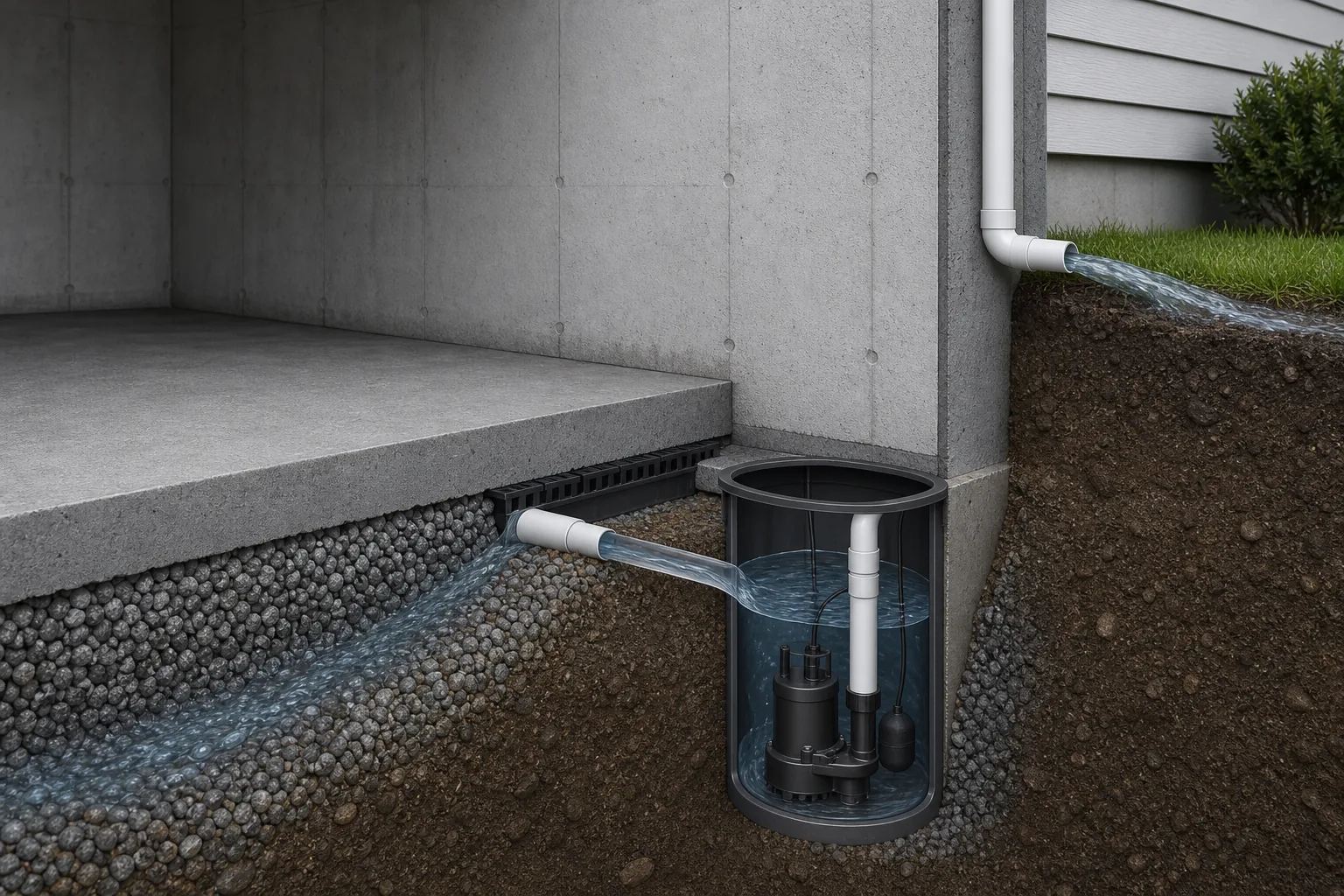
Think of the drain as the collection route and the pump as the exit route. A drain may carry water to a location where gravity can take it away; when that route is not practical, a sump pit and pump can complete the system. Neither name tells you, by itself, why water is reaching the foundation.
| Water-management job | Drainage system role | Sump pump role | Typical arrangement |
|---|---|---|---|
| Collect water at the floor edge | Guides water along the perimeter. | Receives water at the pit. | Interior drainage plus pump |
| Move water uphill from a low basement | Routes water to collection. | Lifts water through discharge piping. | Sump pump installation |
| Redirect water outside the foundation | Collects and directs exterior water. | May not be needed. | Exterior drainage system |
| Address roof runoff at one wall | Not the first check. | Not the first check. | Review gutters and grading |
What does a French drain do inside and outside a house?
“French drain” is a broad term, which is why online comparisons can be confusing. Around a basement, it may describe an interior drain tile or perimeter drain installed at the wall-floor area. Its purpose is to collect water that reaches that low point and direct it toward a sump pit or another outlet.
An exterior drain is outside the foundation, near the footing, and manages water outside. A yard French drain handles landscape surface water and is not automatically a basement-waterproofing system.
Where water appears is a useful clue. Water at the wall-floor joint or along the slab edge after rain points toward a drainage conversation. Water concentrated under one overflowing gutter, beside a low spot, or around a filled window well means the outside water path needs attention too. A visible crack can be an entry point, but its appearance alone does not establish a structural problem.
What does a sump pump do?
A sump pump sits in a sump pit, a basin at a low point in the basement or crawlspace. As water enters the pit, a float mechanism signals the pump to move it through a discharge line away from the home. The pump handles water after it reaches the pit; it does not collect every source of water on its own.
It does not correct a gutter that dumps water next to the foundation or grading that directs runoff toward the house. For a closer look at the parts of the setup, read what a sump pit is and how it works.
French drain or sump pump? Ask these 5 questions first
These are clues to share with an inspector, not a substitute for evaluating the home.
1. Where does water first show up?
Note whether the first sign is on a wall, at the wall-floor joint, through a floor crack, around a window well, or at the sump pit. Photograph the location from a dry, safe area after rain.
2. Does the pattern point to yard runoff or water below grade?
Overflowing gutters, a downspout ending near the house, pooling next to the foundation, or a window well full of debris can concentrate water in one place. Recurring perimeter water calls for a broader drainage assessment.
3. Can the water leave by gravity?
This is the practical dividing line. A drain can guide water toward an available outlet, but a low basement collection point may need a pump to lift water into a discharge line. The answer depends on the home’s layout and drainage route, not on which product name sounds more familiar.
4. Does it happen only in major storms or after most rains?
Keep a simple log of the weather, first wet location, outdoor pooling, and pump activity. A one-time storm and a repeated pattern after ordinary rain are different situations.
5. What happens when the pump cannot run?
A sump pump is a mechanical component, so homeowners should understand their setup and follow the manufacturer’s maintenance guidance. If reliability during an outage is a concern, ask about backup sump pump installation as part of the overall plan. A backup addresses pump availability; it does not replace collecting or redirecting water properly.
Why many basements use both together
Many basement systems pair interior drainage with a sump pump because each takes on a different stage of the water path. The drain collects water near the perimeter and channels it to the sump pit. The pump then sends water out through the discharge line.
That does not mean every home needs both. Exterior drainage may fit water that needs management outside the foundation, while a yard runoff issue may need attention before any below-grade system.
Two common mix-ups to avoid
Do not expect a sump pump to solve exterior runoff: check gutters, downspouts, grading, and window wells first. Likewise, a French drain does not fix a failed pump. If water reaches the pit but does not leave through the discharge route, collection and removal are separate issues. For more water paths, see how water gets into a basement. If water may be from a plumbing or sewer backup, contact a plumber or municipality.
When to call a professional
Schedule an inspection when water repeatedly returns after rain, appears at the wall-floor joint or through the slab, or pools despite clear gutters and improved surface drainage. Call rather than troubleshooting around a wet electrical outlet, cord, or standing water.
A waterproofing professional can compare the water’s location and timing with exterior drainage, foundation conditions, the sump pit, pump operation, and the discharge path. EverDry Waterproofing of Greater Indiana serves Indianapolis and central Indiana homeowners; see its Indianapolis basement waterproofing services and Indianapolis service area.
FAQ
Do I need a sump pump if I have a French drain?
Not always. If a drain can direct collected water to an appropriate gravity outlet, a pump may not be part of that system. Many interior basement drainage systems do feed a sump pit, where a pump moves the water out. The layout and water path determine the answer.
Can a French drain work without a sump pump?
Yes, when the drain has a suitable gravity outlet. In a basement where collected water must be lifted to leave the home, the drainage system and sump pump commonly work together.
Is a French drain the same as drain tile or a perimeter drain?
The terms are often used loosely. In basement conversations, drain tile or perimeter drain often refers to an interior or exterior drainage path around the foundation. A yard French drain is usually a surface-water landscaping solution, so ask what area the term describes.
Which is better for a wet basement: a French drain or a sump pump?
Neither is automatically better. A drain collects and directs water; a pump removes water from the sump pit. The better fit depends on the entry point, exterior drainage, available outlet, and whether water needs to be lifted out.
Will a sump pump stop water coming through basement walls?
A sump pump moves water that reaches its pit. It does not by itself seal a wall, correct grading, clean gutters, or manage every route water takes to the foundation. A recurring wall leak needs an evaluation of the specific water path.
Compare French Drains and Sump Pumps for Your Basement
If water keeps reaching your basement, schedule a free inspection to identify the water path and discuss the next step.
